Laurel
Laurel · Daphne Metamorphosis and Apollo Sacred Tree
Names in Other Languages
 월계수한국어
Laurel · 다프네의 변신, 아폴론의 신성수
 月桂樹日本語
Laurel · ダフネの変身、アポロンの神聖樹
 月桂樹繁體中文
Laurel · 達芙妮的變身, 阿波羅之神聖樹
 LorbeerDeutsch
Laurel · Daphne Verwandlung und Apollon heiliger Baum
 LaurierFrançais
Laurel · La metamorphose de Daphne et l arbre sacre d Apollon
 LaurelEspañol
Laurel · La metamorfosis de Dafne y el arbol sagrado de Apolo
 LoureiroPortuguês
Laurel · A metamorfose de Dafne e a arvore sagrada de Apolo
 WawrzynPolski
Laurel · Przemiana Dafne i swiete drzewo Apollina
 ЛаврРусский
Laurel · Превращение Дафны и священное древо Аполлона
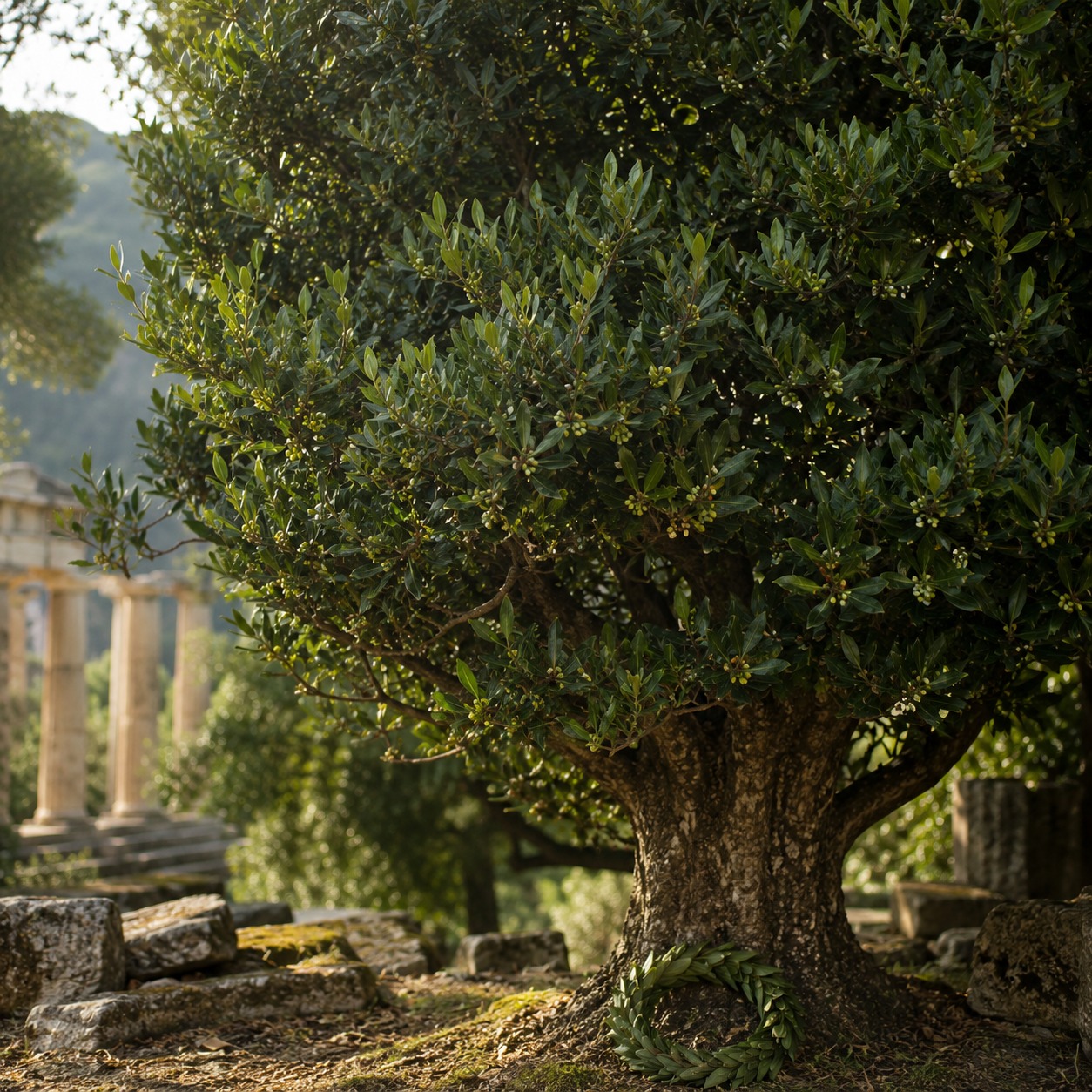
The tree into which the nymph Daphne was transformed while fleeing the pursuit of Apollo. As the sacred tree of Apollo and the medium of the Delphic oracle, and as the source of the triumphal crown placed on the heads of Roman generals, it crosses the Greco-Roman world as a symbol of glory, prophecy, and purification.
Origin
According to Ovid Metamorphoses Book 1, lines 452-567, Daphne was the daughter of the river god Peneus. Apollo, struck by the golden arrow of Eros, fell in love with her, while Daphne, struck by a leaden arrow, loathed him. Pursued to the banks of the river Peneus, Daphne prayed to her father and was transformed into a laurel (Laurus nobilis). Apollo plucked its leaves and swore they would be his eternal wreath.
Features
- Evergreen shrub whose dark green leaves never wither through the year
- Both leaves and berries carry a strong aroma used in ritual and cooking
- Sacred to Apollo; the Pythia chewed its leaves to receive oracles
- Wreaths woven from its leaves marked victory and glory
Stories
At the temple of Apollo in Delphi, the Pythia chewed laurel leaves and inhaled their smoke to deliver oracles. Victors at the Pythian Games were crowned with laurel wreaths. Roman triumphators wore the corona triumphalis as they marched to the Capitoline, and emperors used it as a head ornament and a coin motif. As a symbol of poetic glory, Dante and Petrarch received the laurel crown, and the English word laureate descends from this tradition.
Weakness
Though a token of sacred glory, the laurel carries the weight of the tragedy of Daphne. It is a love forever beyond the reach of Apollo, and the Pythia who chewed its leaves oscillated between ecstasy and madness. The essential oils in the leaves and berries are toxic in large doses, causing hallucinations and poisoning.
Cultural Significance
The tale of Apollo and Daphne opens the metamorphoses of Ovid Book 1 and has been retold throughout Western art, most famously in the 17th-century sculpture Apollo and Daphne by Bernini. Pliny the Elder catalogued laurel varieties and ritual uses in Natural History Book 15, 127-138. Dante invokes the laurel at the opening of Paradiso Canto 1 as the medium of glory. The English baccalaureate (degree conferral) derives from Latin baccalaureus (one crowned with laurel berries), and Nobel laureate carries the same root.
In Popular Culture
- Ovid Metamorphoses Book 1, lines 452-567, 8 CE
- Pliny the Elder Natural History Book 15, 127-138, 1st century
- Homeric Hymn to Apollo, 7th-6th century BCE
- The Pythia oracular ritual at the Delphi temple of Apollo
- Laurel wreath of Pythian Games victors, 6th century BCE-4th century CE
- Corona triumphalis of the Roman triumph
- Dante Paradiso Canto 1, lines 1-36, 14th century
- Bernini Apollo and Daphne sculpture (Galleria Borghese), 1622-1625
Trivia
The name Daphne itself is the Greek word for laurel (δάφνη). The botanical name Laurus nobilis means noble laurel in Latin. The Bernini sculpture captures the very instant of transformation, with leaves sprouting from her fingertips and her legs turning to bark. Alexander the Great wore laurel, and Suetonius records that Julius Caesar often wore a laurel wreath to hide his thinning hair.