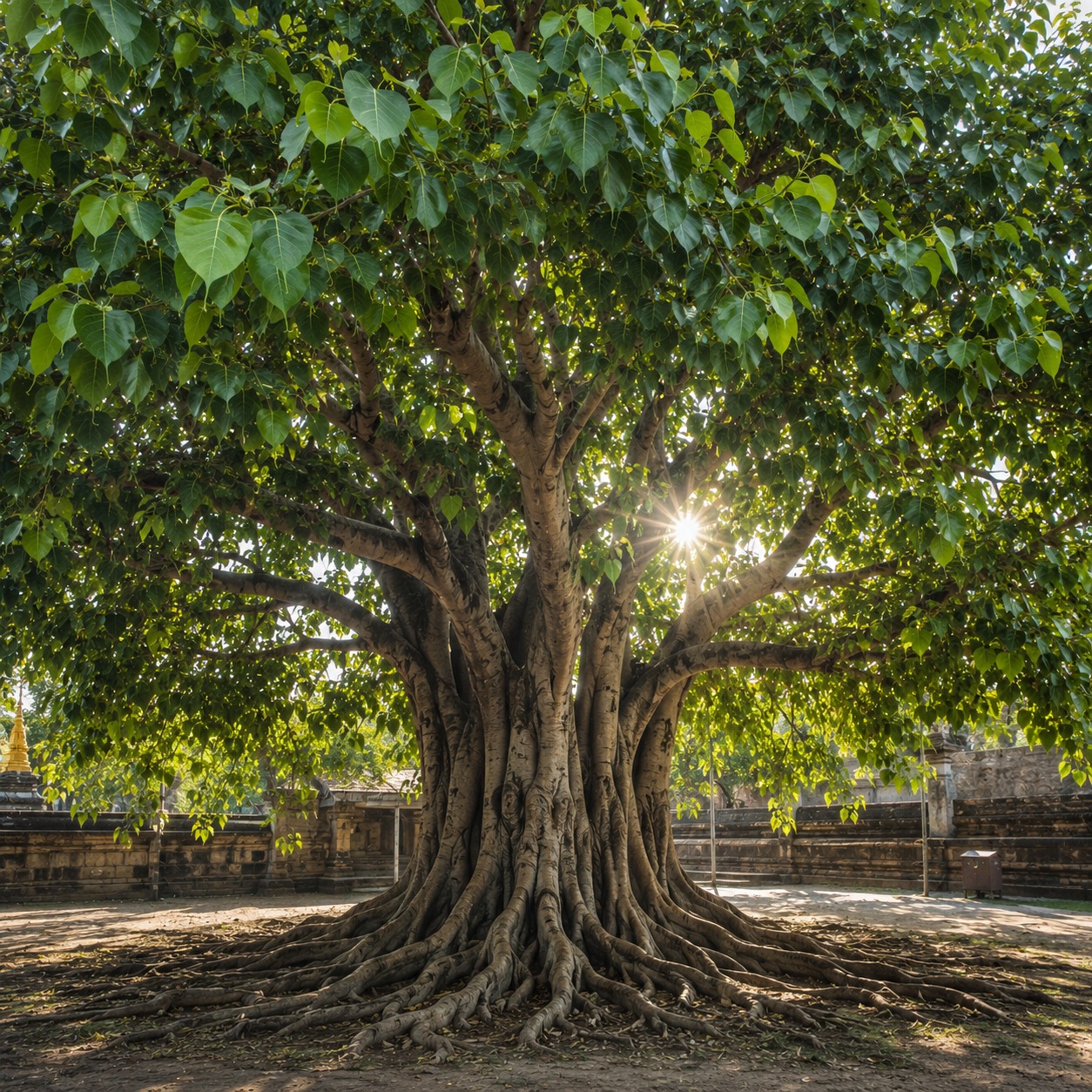
Bodhi Tree
Bodhi Tree · The Sacred Fig Under Which the Buddha Awoke
Names in Other Languages
 보리수한국어
Bodhi Tree · 부처가 깨달음을 얻은 인도보리수
 菩提樹日本語
Bodhi Tree · 仏陀が悟りを開きし印度菩提樹
 菩提樹繁體中文
Bodhi Tree · 佛陀證悟之印度菩提樹
 BodhibaumDeutsch
Bodhi Tree · Der Pippal, unter dem der Buddha erwachte
 Arbre BodhiFrançais
Bodhi Tree · Le figuier sacre sous lequel le Bouddha s eveilla
 Arbol BodhiEspañol
Bodhi Tree · La higuera sagrada bajo la cual el Buda desperto
 Arvore BodhiPortuguês
Bodhi Tree · A figueira sagrada sob a qual o Buda despertou
 Drzewo BodhiPolski
Bodhi Tree · Swieta figowiec, pod ktorym Budda osiagnal przebudzenie
 Дерево БодхиРусский
Bodhi Tree · Священная смоковница, под которой проснулся Будда
The sacred fig of the genus Ficus, beneath which Siddhartha Gautama attained awakening at the age of thirty-five in Bodh Gaya around the 6th century BCE. The Sanskrit bodhi means awakening, and the species name Ficus religiosa means religious fig. The tree now standing beside the Mahabodhi temple in Bodh Gaya descends from the original, while its oldest granddaughter is the Jaya Sri Maha Bodhi planted by the nun Sanghamitta in Anuradhapura, Sri Lanka, in 288 BCE.
Origin
According to the Pali Vinaya Mahavagga Book 1 chapter 1, compiled in oral tradition by about the 1st century BCE, Gautama Siddhartha entered deep meditation beneath a pipal tree (Ficus religiosa) on the banks of the Nairanjana river at Uruvela, the modern Bodh Gaya, and resolved "I shall not rise from this seat until I have attained awakening." He withstood every temptation and assault that Mara raised, and at the breaking of dawn he saw the Four Noble Truths and became the Buddha, the Awakened One. From then on the tree was called Bodhi vrksa, the Tree of Awakening. In 288 BCE the nun Sanghamitta, daughter of the Mauryan king Ashoka, took a branch from the south side of the Bodh Gaya tree to Anuradhapura in Sri Lanka and planted it; that tree, the Jaya Sri Maha Bodhi, holds the longest documented record of a deliberately planted tree in the world.
Features
- Evergreen broadleaf of the family Moraceae, Ficus religiosa
- Heart-shaped leaf ending in a long fine point known as a drip tip
- Leaves quiver in the faintest breeze; tradition reads this as the Buddha teaching even in the wind
- A single tree lives for thousands of years, sending down aerial roots that branch into many trunks
- The most common sacred tree planted in temples across India, Sri Lanka, and Southeast Asia
Stories
Besides the Jaya Sri Maha Bodhi of 288 BCE, the present tree in Bodh Gaya was raised by the British archaeologist Alexander Cunningham in 1881 from a granddaughter shoot of the Sri Lankan tree, when he restored the Mahabodhi temple from ruin. Bodhi leaves serve in Buddhist practice as amulets, manuscript covers, and the cords of prayer beads, and the dried lacework of the leaf, with only the veins remaining, is a standard temple offering in Southeast Asia. For medicine the Susruta Samhita and Caraka Samhita of around the 6th century BCE prescribed the bark of the pipal for asthma, diabetes, and indigestion. In Korea and Japan temple grounds carry a tree called bodhi as well, but as the Indian pipal cannot survive their winter, most temples planted the linden Tilia or related species in its stead.
Weakness
The original Bodh Gaya tree was destroyed more than once. After the Mauryan house, the Sunga king Pushyamitra of 185 to 149 BCE "burned the Bodhi tree," as the Divyavadana records, and the 7th-century Korean pilgrim Hyecho noted scars of fire when he visited. A storm felled it again in 1876, and Cunningham planted a shoot from the Sri Lankan granddaughter in its place. The Bodhi tree cannot easily grow outside the tropical climate of India and Sri Lanka, and most so-called bodhi trees in Korea, Japan, and China are other species. The aerial roots of the Ficus religiosa can also break temple masonry, and the Mahabodhi temple has its tree pruned on an eight-century cycle.
Cultural Significance
The Jaya Sri Maha Bodhi of Anuradhapura, guarded since 288 BCE, holds the longest documented life of a tree planted by humans, and it was inscribed on the UNESCO World Heritage list in 1991. The Poson festival in May or June brings hundreds of thousands of pilgrims each year. The Mahabodhi temple at Bodh Gaya was inscribed on the UNESCO list in 2002, and beside the tree of awakening stands the sandstone Vajrasana, the diamond throne, marking the seat of the Buddha awakening. In Korea the Samguk Yusa records that a Bodhi tree was planted at Bunhwangsa in Silla times as the seat of right awakening, though the tree itself perished. The Qing Yongzheng emperor planted in 1727 a shoot of the Bodh Gaya tree at the palace of Beijing, but it withered in the winter, as the Qing Shi Gao records.
In Popular Culture
- Pali Vinaya Mahavagga Book 1 chapter 1 on the Buddha awakening, oral compilation 1st century BCE
- Mahaprajnaparamita Sutra on the Bodhi tree, c. 1st century
- Susruta Samhita on the medicinal use of pipal, c. 6th century BCE
- Divyavadana on the burning of the Bodhi tree by Pushyamitra, c. 2nd century
- Hyecho Wang ocheonchukgukjeon on Bodh Gaya, 727
- Xuanzang Da Tang Xiyu Ji book 9 on the Bodhi tree, 646
- Samguk Yusa on the planting of a bodhi at Bunhwangsa, 1281
- Qing Shi Gao on Yongzheng planting of the Bodhi shoot, compiled 1928
- Alexander Cunningham report on the Mahabodhi temple, 1881
- UNESCO inscription of the Mahabodhi temple complex, 2002
Trivia
Sanskrit bodhi comes from the root budh, to wake, the same root as Buddha. The Bodhi leaf trembles constantly because the petiole is long and fine, and Indian tradition reads this as the Buddha doctrine flowing without pause. The Jaya Sri Maha Bodhi has been guarded for more than 2300 years and an armed soldier still stands watch around the clock. The bodhi trees of Korea and Japan are mostly lindens or Tilia mandshurica, botanically unrelated to the Ficus religiosa of Bodh Gaya, so to specify the Buddha tree one says Indian pipal or Indian bodhi.