High Elf
High Elf · Noble Elves — Aristocrats of Arcane Magic
Names in Other Languages
 하이엘프한국어
High Elf · 고위 엘프 — 비전 마법의 귀족 혈통
 ハイエルフ日本語
High Elf · 高位エルフ — 秘術魔法の貴族血統
 高等精靈繁體中文
High Elf · 高位精靈 — 秘法魔法的貴族血統
 HochelfDeutsch
High Elf · Edle Elfen — Aristokraten der Arkanmagie
 Haut-ElfeFrançais
High Elf · Elfes nobles — Aristocrates de la magie arcanique
 Alto ElfoEspañol
High Elf · Elfos nobles — Aristócratas de la magia arcana
 Alto ElfoPortuguês
High Elf · Elfos nobres — Aristocratas da magia arcana
 Wysoki ElfPolski
High Elf · Szlachetne elfy — arystokraci magii arkanicznej
 Высший эльфРусский
High Elf · Благородные эльфы — аристократы тайной магии
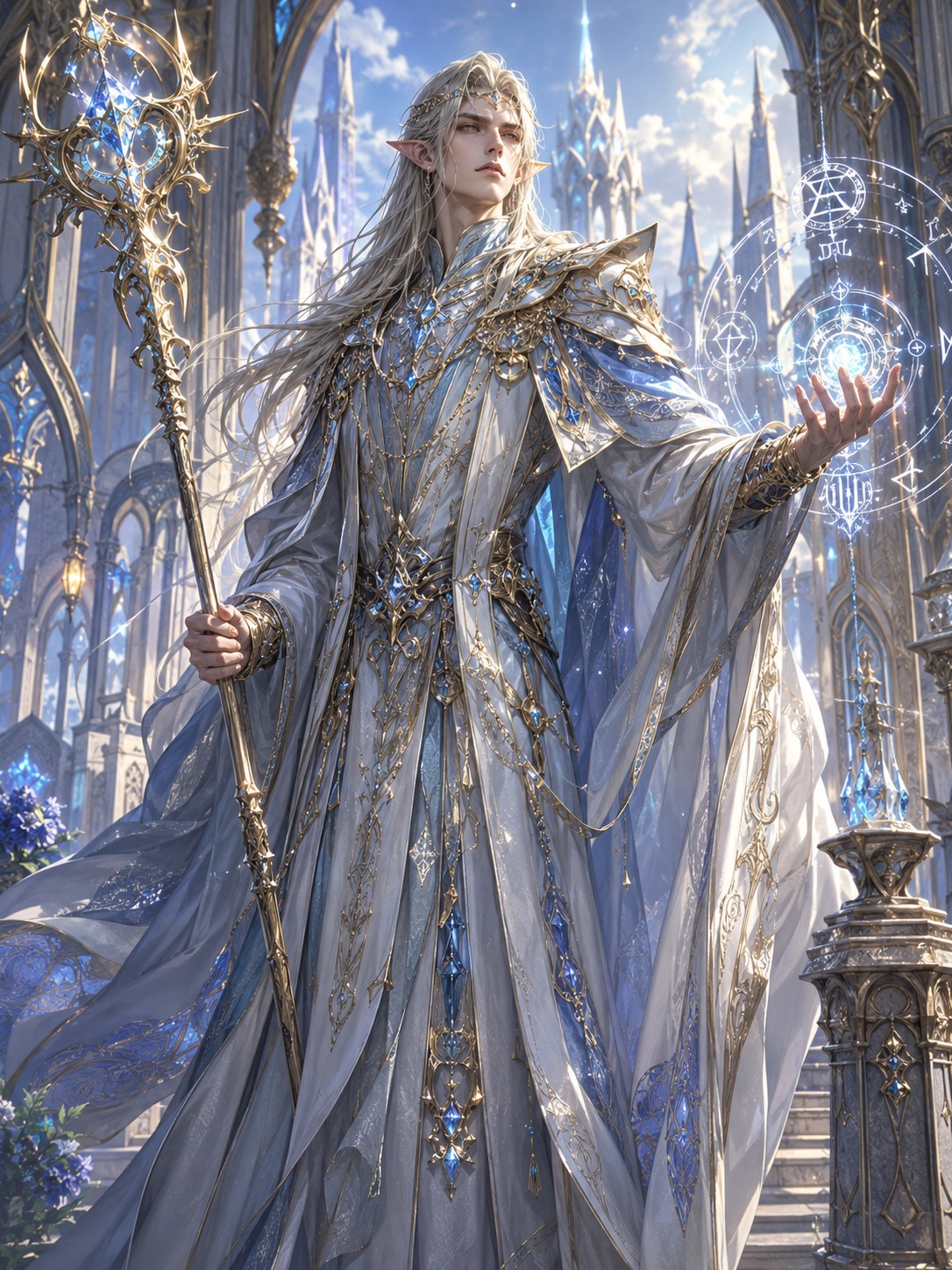
An elven aristocracy of light and high arcana, with hair of gold or silver, ornate robes, and a mastery of arcane magic that rises above all other elven branches. They are the ruling caste of elven realms and the keepers of an ancient magical civilisation, prouder and more closed than their lesser-elven kin. J. R. R. Tolkien's Noldor in The Silmarillion (George Allen & Unwin, 1977) fixed the modern archetype; Dungeons & Dragons (Advanced Players Handbook 2nd ed., TSR, 1989; 5th ed. PHB, 2014), Games Workshop's Asur of Ulthuan in Warhammer Armies: High Elves (1993), and Blizzard's Quel'dorei in World of Warcraft (2004) have made the fantasy template.
Origin
The Tolkienian root of the high elf is the Noldor, the second of the Eldar tribes — Vanyar (the highest, who remained in Aman), Noldor (seekers of craft and lore), and Teleri (the sea-elves) — who answered the call to the Light of Valinor. After the Two Trees of Valinor were destroyed by Melkor and their light was sealed in the Silmarils, the Noldor under Feanor returned to Middle-earth to recover the gems, an event whose curse drives much of the Silmarillion. The drafts of this mythology run from the Book of Lost Tales (c. 1916, in The History of Middle-earth vols. 1-2 ed. Christopher Tolkien, 1983-84) and were published posthumously by Christopher in 1977. In Appendix F of The Lord of the Rings (1954-55), Tolkien designated their tongue Quenya — 'the Latin of the elves' — modelled, as he told W. H. Auden in 1955, on Finnish phonology and Latin morphology. Galadriel, Gil-galad, and Elrond (half-Noldor) all descend from this line. Dungeons & Dragons introduced the High Elf as a distinct elven subrace in the Advanced Dungeons & Dragons Players Handbook second edition (TSR, 1989), and the fifth-edition Players Handbook (Wizards of the Coast, 2014) gave them a wizard cantrip, an additional weapon proficiency, and an additional language as racial features. Games Workshop's Warhammer Armies (1985) introduced the High Elves; the Warhammer Armies: High Elves volume of 1993 (Rick Priestley et al.) fixed the island of Ulthuan, its capital Lothern, the supreme god Asuryan, and the Phoenix King polity. Blizzard's Warcraft II: Tides of Darkness (1995) introduced the Quel'dorei, and the World of Warcraft expansion The Burning Crusade (2007) transformed them into Sin'dorei (Blood Elves) gripped by magical addiction.
Features
- Height roughly five foot eight to six foot two (1.73-1.88 m), slightly taller than common elves, slender and stately
- Hair of gold, silver, or pale platinum, eyes of blue or violet, faintly luminous skin
- Deep affinity with arcane magic — the fifth-edition D&D high elf learns a wizard cantrip by default, the Asur mage of Warhammer can practise all eight Lores of Magic
- Refined court tongues such as Quenya and Sindarin (Tolkien), Eltharin (Warhammer), and Thalassian (Warcraft), and a literate runic-stone civilisation
- Lifespan of about 750 to 1,200 years in fifth-edition D&D (effectively immortal among Tolkien's Noldor), garments of silk, silver, and mithril
Stories
High elves appear as the ruling caste of magical kingdoms, as proud archmagi and sages, and as keepers of ancient knowledge. In Tolkien, Galadriel rules Lothlorien as the last great Noldor sovereign in Middle-earth and Gil-galad, last High King of the Noldor, dies in the Last Alliance against Sauron. The Asur of Warhammer hold a two-front war against Empire and Druchii with magical fleets, and the Quel'dorei of Warcraft form the core of the Kirin Tor magical college. The Altmer of The Elder Scrolls govern the Summerset Isles and operate the racially supremacist Thalmor regime, a twenty-first-century critical inversion of the older archetype. The figure is canonical to stories of pride and decline, in which fixity in magic and birth becomes a tragic flaw.
Weakness
Pride and bloodline absolutism are the central weaknesses. Tolkien's Feanor leaves Valinor under his obsession with the Silmarils and commits the First Kinslaying, drawing the Doom of the Noldor down on his people. The Warhammer Asur, leaning on magic, have lost roughly half their numbers in the millennium-long war with their Druchii kin, and Warcraft's Sin'dorei split the race when they turn to fel demonic magic to feed their craving. Refusal of change, contempt for humans and lesser elves, and closed self-regard make alliance-building difficult. Mechanically the fifth-edition D&D high elf gains immunity to sleep and charm but is short on hit points and has weak divine spellcasting affinity compared with humans or dwarves.
Cultural Significance
The high elf descends from Tolkien's mythopoetic synthesis of the late nineteenth-century Celtic Revival (William Butler Yeats, The Celtic Twilight, 1893) and the Finnish national epic Kalevala (Elias Lonnrot, 1835 and 1849). Tolkien wrote to W. H. Auden in 1955 that Quenya combined Finnish phonology and Latin morphology with Greek lexicon. Dungeons & Dragons and Warhammer in the 1980s and 90s reshaped the type into the canonical 'arrogant arcane aristocrat'; Michael Moorcock's Wizardry and Wild Romance (Gollancz, 1987) read this as a critical symbol of Victorian-Edwardian English aristocracy. In the twenty-first century the figure is increasingly reread critically, exemplified by the Thalmor of Elder Scrolls and the addiction-driven Sin'dorei of Warcraft. Japanese light novels following the Sword World RPG (Group SNE, 1989) tend to recast the high elf as a more sympathetic companion than its Western prototype.
In Popular Culture
- J. R. R. Tolkien, The Silmarillion (Allen & Unwin, 1977) — the Noldor, Feanor, Galadriel
- Tolkien, The Lord of the Rings (1954-55), Appendix F — elven classification and Quenya
- David 'Zeb' Cook et al., Advanced Dungeons & Dragons Players Handbook 2nd ed. (TSR, 1989) — high elf as subrace
- Rick Priestley et al., Warhammer Armies: High Elves (Games Workshop, 1993) — Ulthuan, Asuryan, the Phoenix King
- Blizzard, Warcraft II: Tides of Darkness (1995), World of Warcraft (2004), The Burning Crusade (2007) — Quel'dorei and Sin'dorei
- Bethesda, The Elder Scrolls II: Daggerfall (1996) and The Elder Scrolls Online (2014) — Altmer and Thalmor politics
- Wizards of the Coast, Dungeons & Dragons Players Handbook 5th ed. (2014) — high elf as standard subrace
- Group SNE, Sword World RPG (1989) — Japanese high elf canon
- Andrzej Sapkowski, The Witcher series (supeRNOWA, 1990s onward) — Aen Seidhe and Aen Elle high elves
- Larian Studios, Baldur's Gate 3 (2023) — many high-elf NPCs
Trivia
- In a 1955 letter to W. H. Auden (Letters of J. R. R. Tolkien no. 163), Tolkien wrote that Quenya was built from Finnish phonology and Latin morphology with a Greek lexical layer; the same mix lies under every high-elven name later writers would coin.
- Rick Priestley said in a 2010 Black Library interview that the Asur high-elven fleet of Warhammer Armies: High Elves (1993) was directly modelled on the eighteenth-century British ship of the line, a citation that critics have read as a colonial-era allusion.
- At BlizzCon 2007 Chris Metzen explained that the Sin'dorei switch from the Alliance to the Horde in The Burning Crusade was a deliberate narrative of 'magical addiction that drives a high-elf race into moral compromise'.
- A pencil self-portrait of Feanor by Tolkien (c. 1937, Bodleian Library) bears the marginal note 'eyes sealed with the light of the Two Trees', the iconographic seed for the 'glowing eyes' marker of the high elf in later visual canon.
Related
Elf
Elf · People of the Forest — Longevity, Magic, Guardians of Nature
Half-Elf
Half-Elf · Of Mixed Blood — Between the Worlds of Human and Elf
Troll
Troll · The Regenerating Giant — A Savage Race of Tenacious Vitality
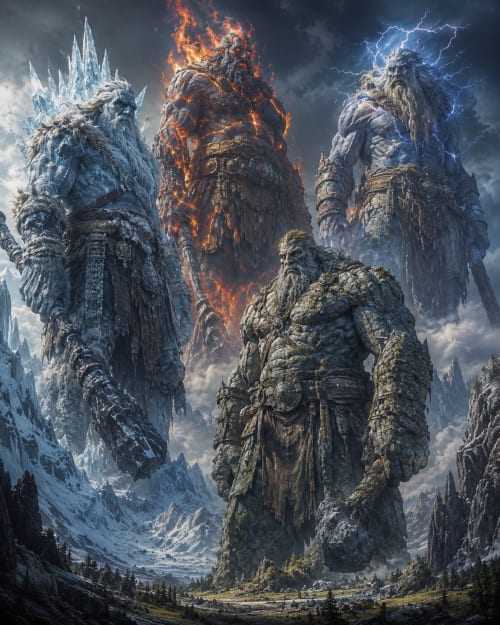
Giant-kin
Giant-kin · The Giant Race — Primal Titans Like Living Mountains
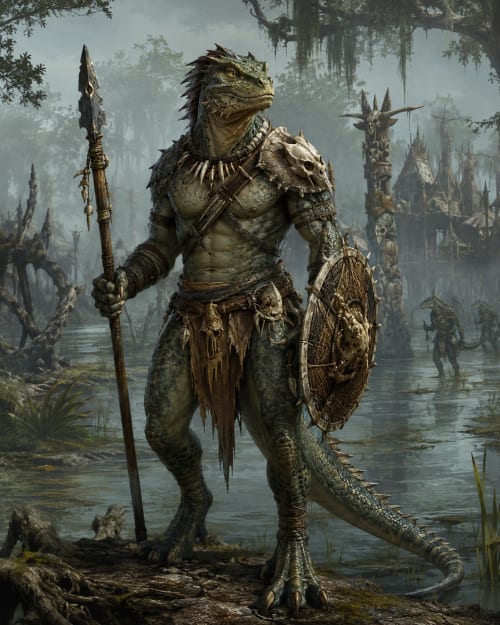
Lizardfolk
Lizardfolk · The Lizard People — Cold-Blooded Tribal Warriors of the Marsh
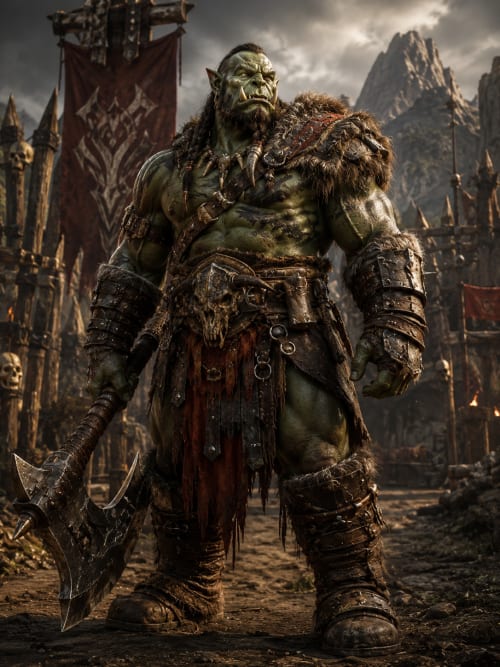
Orc
Orc · Warrior Tribes — A Fierce Race That Reveres Strength and Honor
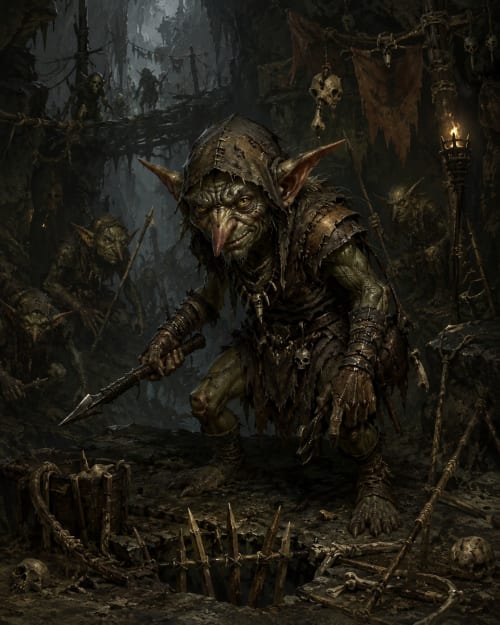
Goblin
Goblin · The Cunning Little Folk — Raiders Who Live by Numbers and Guile
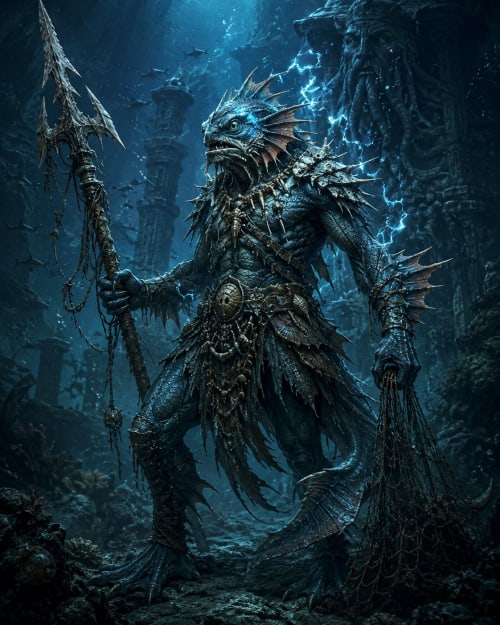
Fishfolk
Fishfolk · The Deep-Sea Fish People — Wild Tribes of the Abyss
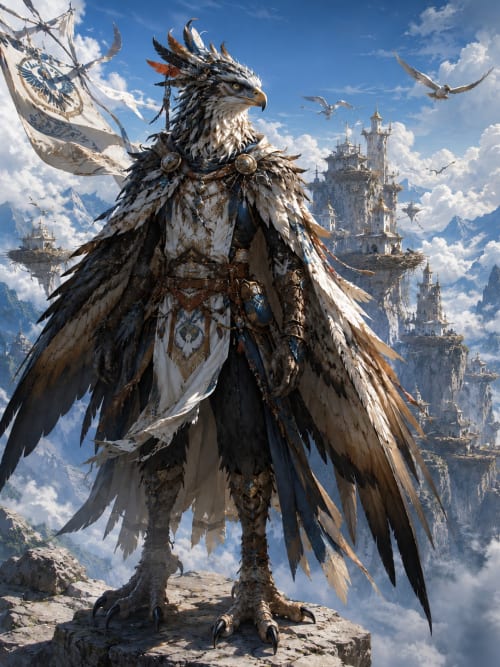
Birdfolk
Birdfolk · The Bird People — A Mountain-Peak Race That Flies the Skies
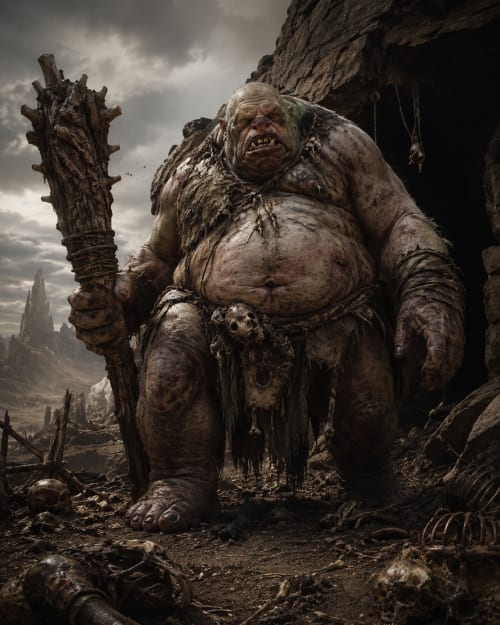
Ogre
Ogre · The Man-Eating Giant — A Dull, Cruel Tyrant of the Wilds
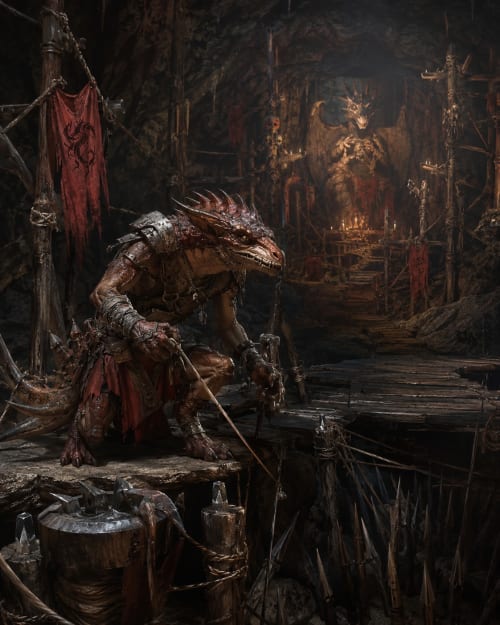
Kobold
Kobold · The Dragon-Serving Little Folk — Masters of Traps
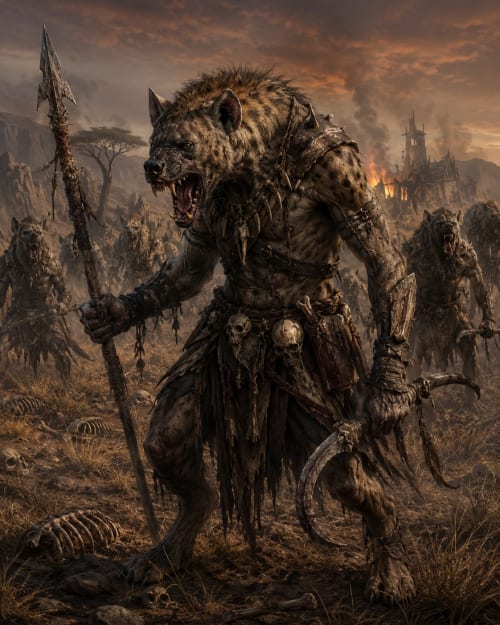
Gnoll
Gnoll · The Hyena People — A Raiding Tribe Maddened by Hunger