Gnoll
Gnoll · The Hyena People — A Raiding Tribe Maddened by Hunger
Names in Other Languages
 놀한국어
놀한국어Gnoll · 하이에나 인간 — 굶주림에 미친 약탈 부족
 ノール日本語
Gnoll · ハイエナ人間 — 飢えに狂った略奪部族
 豺狼人繁體中文
Gnoll · 鬣狗人 — 為飢餓所狂之掠奪部族
 GnollDeutsch
Gnoll · Das Hyänenvolk — Ein von Hunger wahnsinniger Raubstamm
 GnollFrançais
Gnoll · Le peuple hyène — Une tribu de pillards rendue folle par la faim
 GnollEspañol
Gnoll · El pueblo hiena — Una tribu saqueadora enloquecida por el hambre
 GnollPortuguês
Gnoll · O povo hiena — Uma tribo saqueadora enlouquecida pela fome
 GnollPolski
Gnoll · Lud hien — plemię rabusiów oszalałe z głodu
 ГноллРусский
Gnoll · Народ гиен — племя налётчиков, обезумевшее от голода
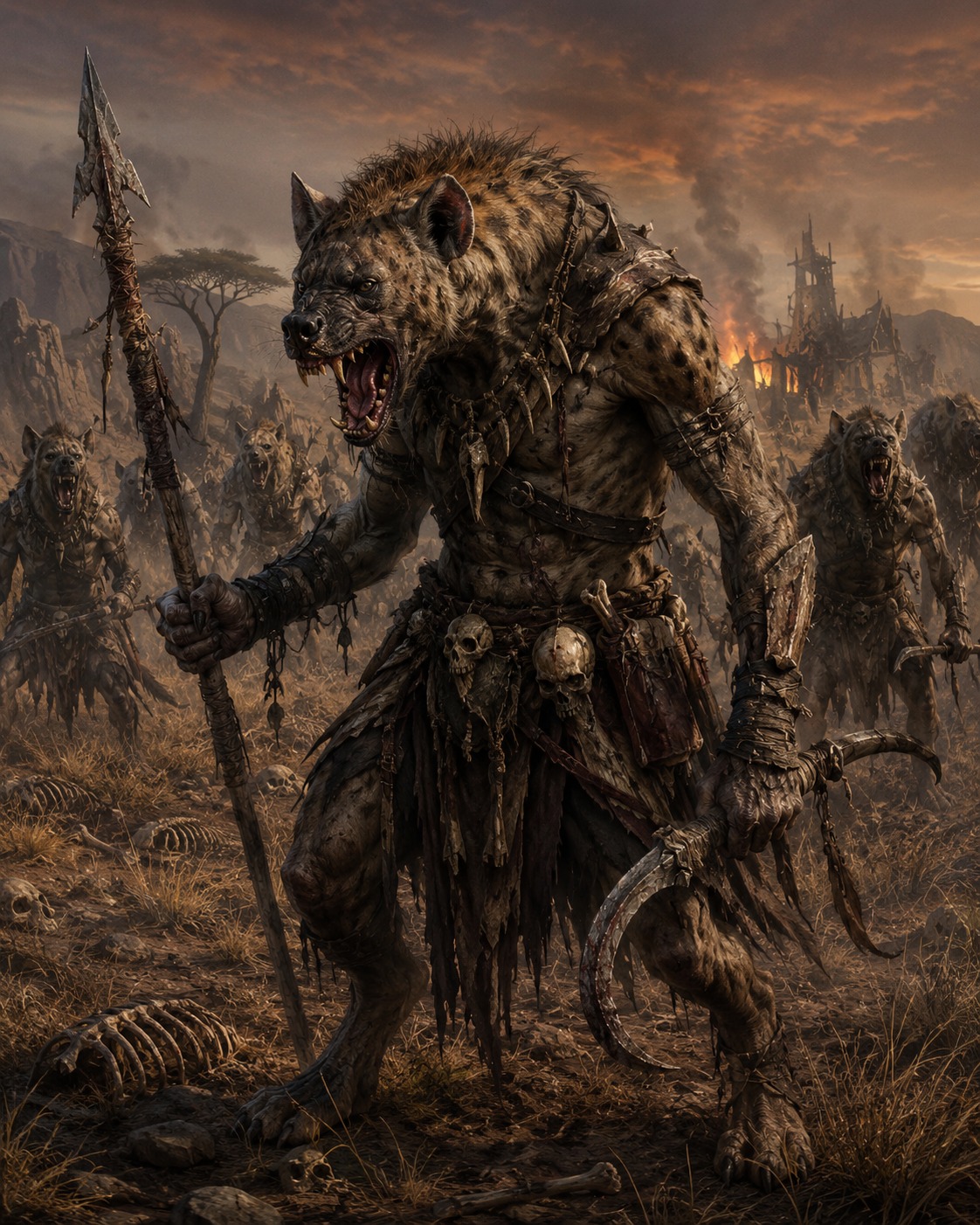
The gnoll is a hyena-headed humanoid raider race introduced by Gary Gygax in the 1974 Dungeons & Dragons original boxed set and codified in the 1977 AD&D Monster Manual as a Chaotic Evil scavenger tribe (Challenge Rating 1/2) that worships the demon-prince of hunger and slaughter, Yeenoghu. The name was acknowledged by Gygax himself, in 'Strategic Review' issue six (1976) and in his 'Dragon Magazine' issue one hundred interview of 1985, as a borrowing from the 'gnole' of Lord Dunsany's short story 'How Nuth Would Have Practised His Art upon the Gnoles' in 'The Book of Wonder' (1912); the form is also commonly read as a portmanteau of 'gnome' and 'troll'. Gnolls stand two hundred and ten to two hundred and twenty centimetres tall, with the rough muscular build of a hominid, the head and brown-grey spotted coat of the spotted hyena (Crocuta crocuta), human-like clawed fingers and a chilling whooping laughter taken from the spotted hyena's territorial call. They live in nomadic packs of four to twelve in savannas, badlands and arid wastes, and obey a Gnoll Fang of Yeenoghu — a warrior touched by the demon-prince. The fifth-edition 'Volo's Guide to Monsters' (2016) makes the canon explicit: gnolls are not a naturally breeding species but the result of Yeenoghu's demon-ichor mutating spotted hyenas. The lineage is borrowed in the Gnoblars of Games Workshop's Warhammer Fantasy, the marogh of BioWare's 'Dragon Age: Inquisition' (2014) and the gnoll raiders of Black Isle's 'Baldur's Gate' series (from 1998).
Origin
The direct textual source is the 1974 original boxed set of Dungeons & Dragons by Gary Gygax and Dave Arneson, with the alignment, statistics and Yeenoghu cult fixed in the 1977 AD&D Monster Manual. Gygax confirmed in 'Strategic Review' issue six (TSR's house publication, 1976) and again in his 'Dragon Magazine' one hundred interview (1985) that 'gnoll' is borrowed from the 'gnole' of Lord Dunsany's short story 'How Nuth Would Have Practised His Art upon the Gnoles' in 'The Book of Wonder' (1912), where the gnoles are non-human forest-dwellers whose exact appearance is left unstated. Gygax fused the borrowed name with the spotted-hyena iconography to invent the modern gnoll. The mutation cosmology — gnolls born when Yeenoghu's demon-ichor transforms spotted hyenas — was elaborated in 'Fiend Folio' (2002, third edition) and most fully in 'Volo's Guide to Monsters' (2016, Mike Mearls and others). Yeenoghu himself was codified as a Demon Prince of bestial hunger in 'Eldritch Wizardry: Supplement III' (1976).
Features
- Two hundred and ten to two hundred and twenty centimetres tall, muscular hominid raider
- Spotted-hyena (Crocuta crocuta) head, brown-grey spotted coat, human-like clawed fingers
- Chilling whooping laughter borrowed from the spotted hyena's call
- Nomadic packs of four to twelve in savannas, badlands and arid wastes
- Worshippers of the demon-prince Yeenoghu, prince of hunger and slaughter
- Chaotic Evil alignment, Challenge Rating 1/2 in fifth edition, scavenges and eats both the living and the dead
Stories
Functions as the canonical non-negotiable raider antagonist in tabletop role-playing campaigns and as a focal figure for stories of madness, hunger and the savagery that threatens civilisation. The Yeenoghu-cult setting introduces religious-madness, demon-worship and mass-slaughter motifs into the campaign. The same iconography has been borrowed for Games Workshop's Gnoblars in Warhammer Fantasy, BioWare's 'Dragon Age: Inquisition' (2014) and the gnoll raiders of Black Isle Studios's 'Baldur's Gate' series (from 1998).
Weakness
Dominated by hunger and impulse, gnolls have weak discipline and poor long-term strategy, and the pack disintegrates rapidly when its Fang or Yeenoghu's blessing is severed. Greed and appetite expose them to bait and trap tactics, and at Challenge Rating 1/2 individual combat power is low enough that an adventuring party can clear a pack in a single encounter.
Cultural Significance
The figure is a composite of ancient Egyptian and African folklore around the spotted hyena — the Plinian 'Naturalis Historia' (book VIII) on hyenas mimicking human speech, the grave-robbing hyena of medieval European bestiaries (Aberdeen Bestiary, twelfth century) — fused with Dunsany's literary 'gnole' and channelled through D&D into the post-1980 English-language fantasy mainstream.
In Popular Culture
Gary Gygax's D&D original boxed set (1974), the AD&D Monster Manual (1977), 'Eldritch Wizardry: Supplement III' (1976) for Yeenoghu, 'Fiend Folio' (2002, third edition), the fifth-edition Monster Manual (2014), 'Volo's Guide to Monsters' (2016), Lord Dunsany's 'The Book of Wonder' (1912) for the etymological 'gnole', Games Workshop's Gnoblars in Warhammer Fantasy (from 1999), BioWare's 'Dragon Age: Inquisition' (2014) and Black Isle Studios's 'Baldur's Gate' series (from 1998).
Trivia
Gygax's identification of Dunsany's 'gnoles' as the source of 'gnoll' in 'Strategic Review' issue six (1976) is one of the best-known etymological provenances in the history of D&D race-naming, restated in his 'Dragon Magazine' one hundred interview of 1985. Yeenoghu's signature weapon, the Flail of Yeenoghu, is a triple-headed morning star first described in 'Eldritch Wizardry' (1976) and unchanged through to the fifth edition.