Azure Dragon
靑龍 · Eastern Guardian of the Four Symbols
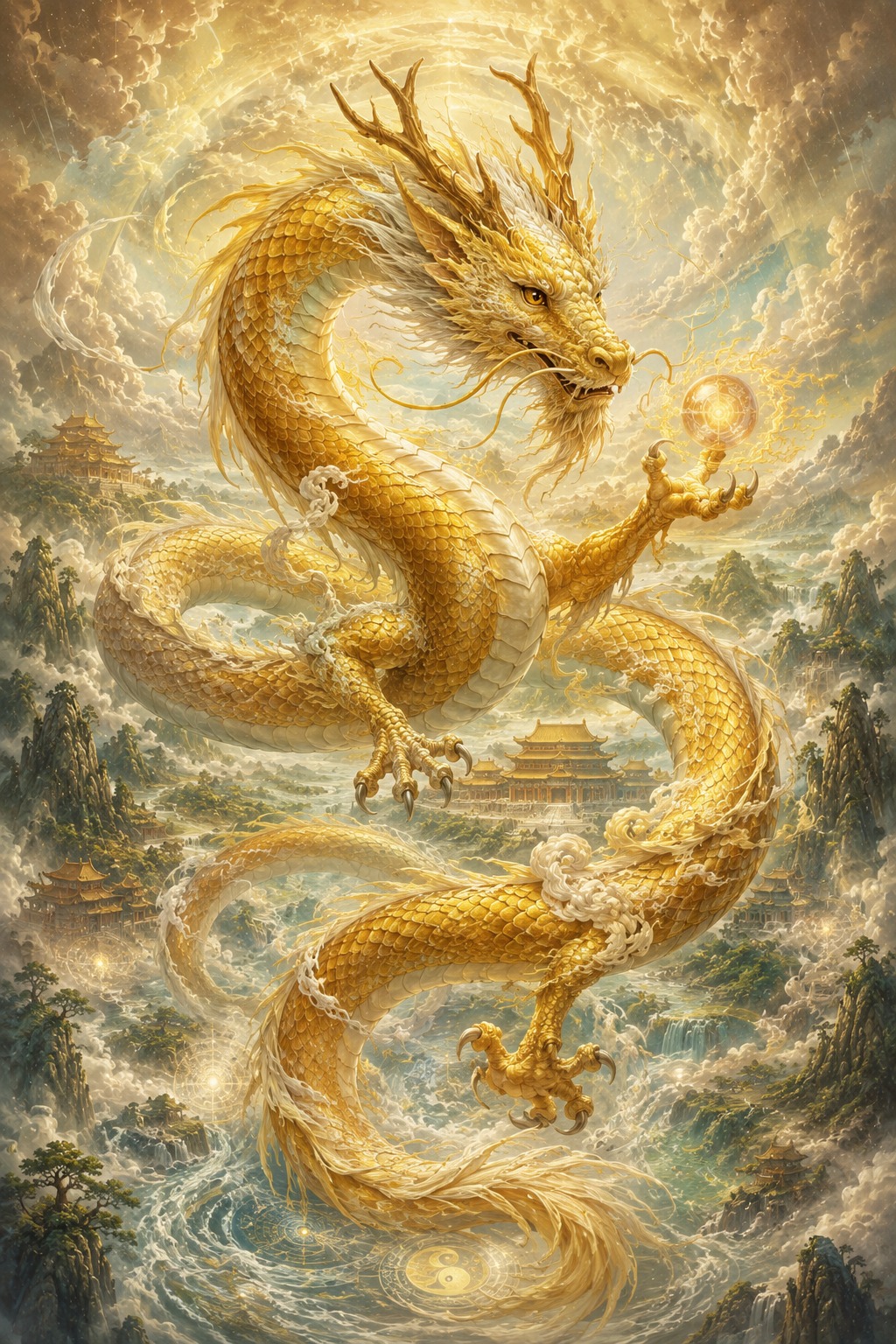
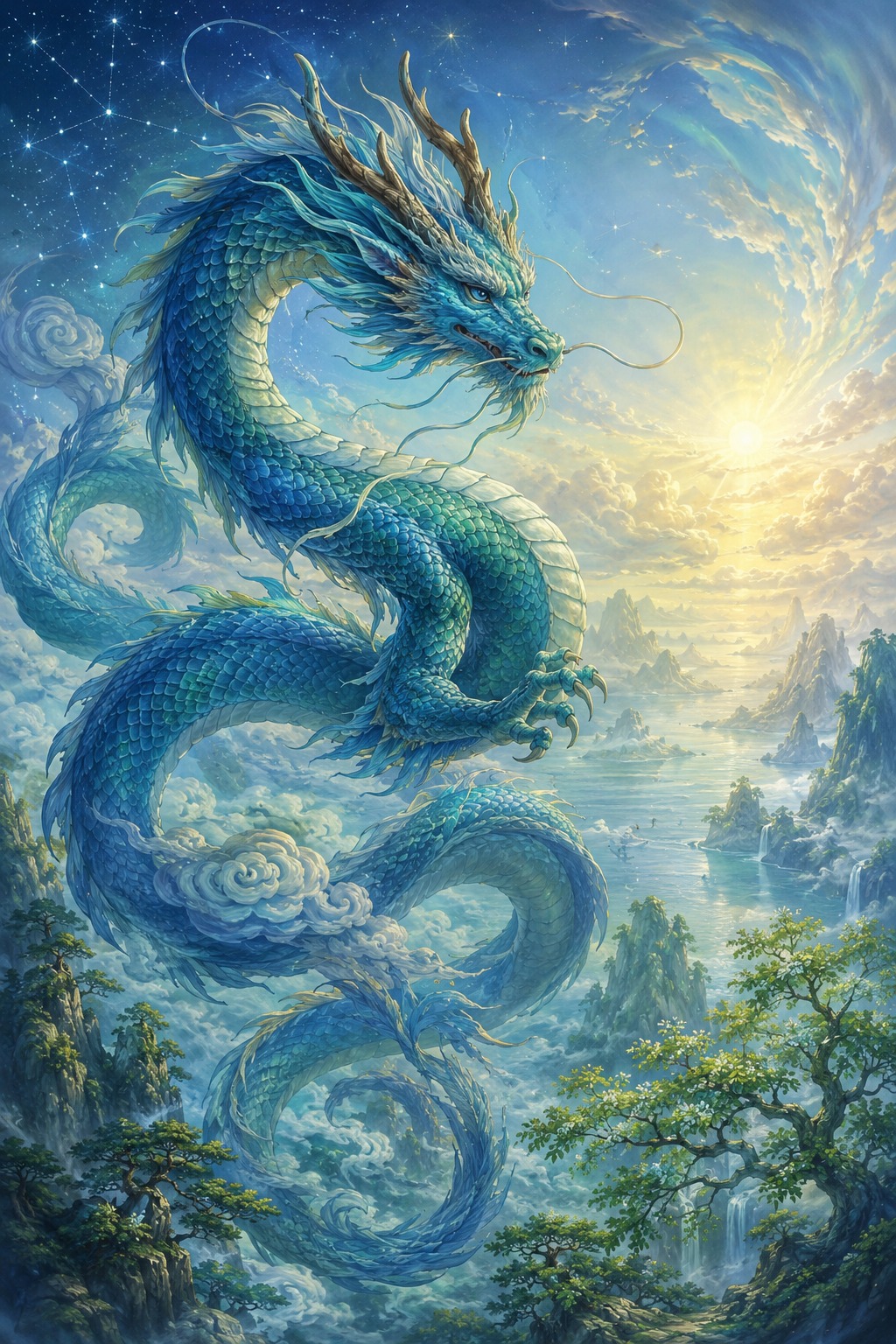
The Azure Dragon (Chinese 'Qinglong', Korean 'Cheongnyong', Japanese 'Seiryu') is the eastern guardian of the East-Asian Four Symbols (sasin / Sishen), the celestial dragon governing the East, the spring, the Wood phase of the five elements and the colour green-blue. The system — Azure Dragon of the East, White Tiger of the West, Vermilion Bird of the South, Black Tortoise of the North — was codified under the Han dynasty, in particular the 'Huainanzi' (c. 139 BCE) of Liu An and Wang Chong's 'Lunheng' (c. 80 CE), and unifies the seven lunar mansions of the eastern quadrant (Jiao, Kang, Di, Fang, Xin, Wei, Ji). Visually the Azure Dragon is distinguished from the imperial yellow long by a slimmer, more serpentine body, a green-blue scale-pattern, branched deer-style antlers and carp scales; it is the canonical image of the geomantic principle that the dragon of the East guards the left side of a settlement. The best-preserved early representations are the eastern murals of the Goguryeo tombs Gangseo Daemyo and Jungmyo (late sixth century, South Pyongan, North Korea) and the late-seventh- to early-eighth-century Kitora Tomb (Asuka village, Nara prefecture, Japan, recognised as a National Treasure in 1998). The Azure Dragon also names the Cheongwadae presidential residence in Korea ('house of green tiles', built 1939) and watches over the Eastern Flowery Gate (Donghuamen) of the Forbidden City completed in 1420.