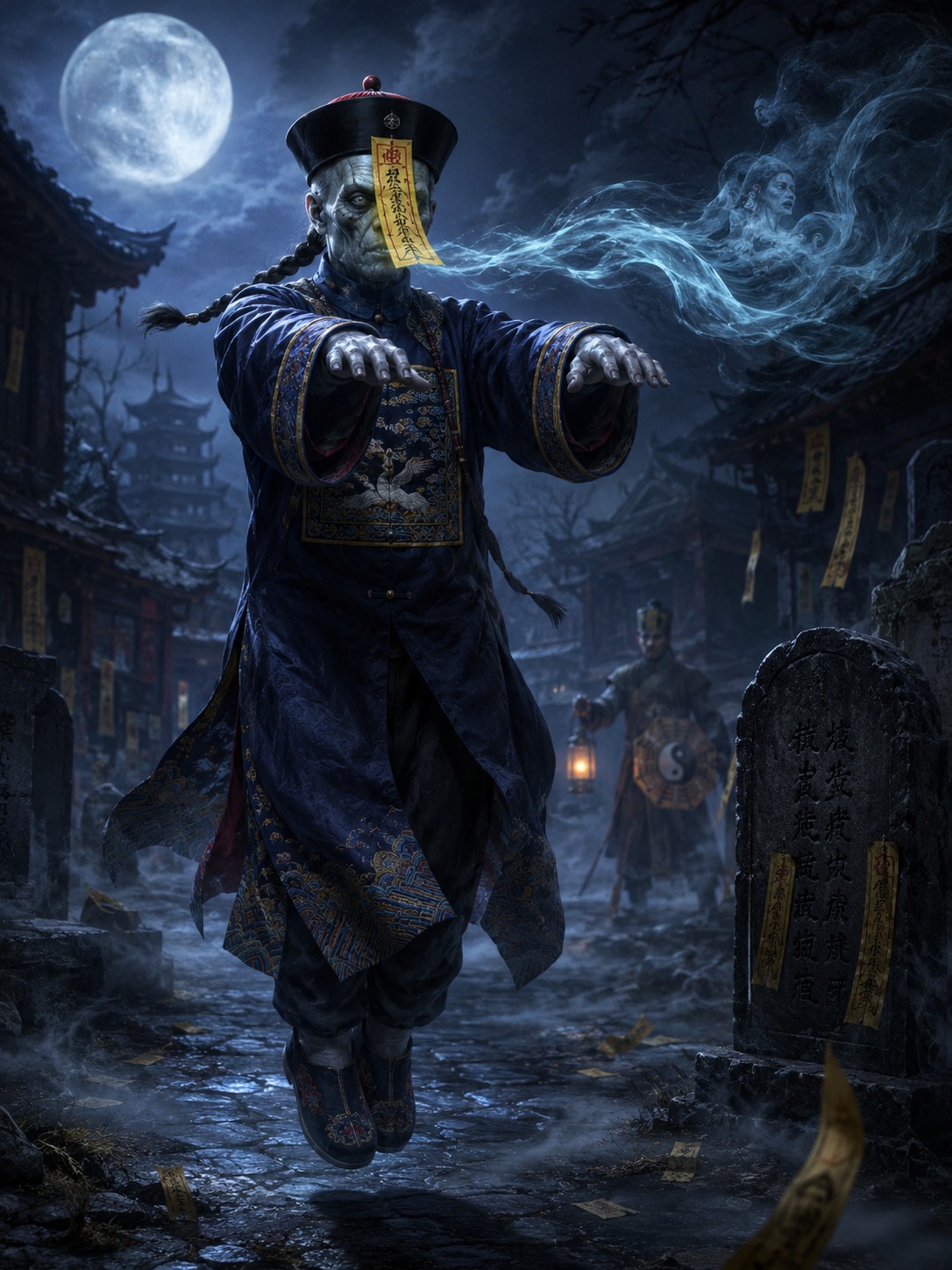
Jiangshi
Jiangshi · The Chinese Hopping Corpse — A Stiff, Leaping Corpse-Spirit
The Jiangshi (Chinese jiangshi, 'stiff corpse') is the Chinese corpse-yokai of an unburied dead body grown rigid and reanimated. The figure is defined by post-mortem rigor that holds its arms outstretched, by the canonical hopping motion in which it moves with both feet together, by the Qing-dynasty Manchu official's robe (magua) and round cap, and by its qi-draining (xi jing) nature: it absorbs the life-energy of the living through its breath. The etymology is jiang ('stiff') plus shi ('corpse'), so 'stiff corpse'. The figure entered formal Chinese literature in the late eighteenth century through Yuan Mei's Zibuyu (1788) and Ji Yun's Yuewei caotang biji (1789-1798), the Qing-era biji notation collections. The iconographic root is the Hunan Xiangxi corpse-walking custom (ganshi), in which a Daoist sorcerer was said to lead the bodies of those who died abroad home through the night using talismans. Lau Koon-wai's 1985 Hong Kong film Mr. Vampire, starring Lam Ching-ying, decisively fixed the modern hopping-jiangshi iconography and launched the Hong Kong jiangshi-film boom of 1985-1992.